
News
How Does a Peptide Factory Achieve Scaled Production from Milligram to Kilogram Levels?
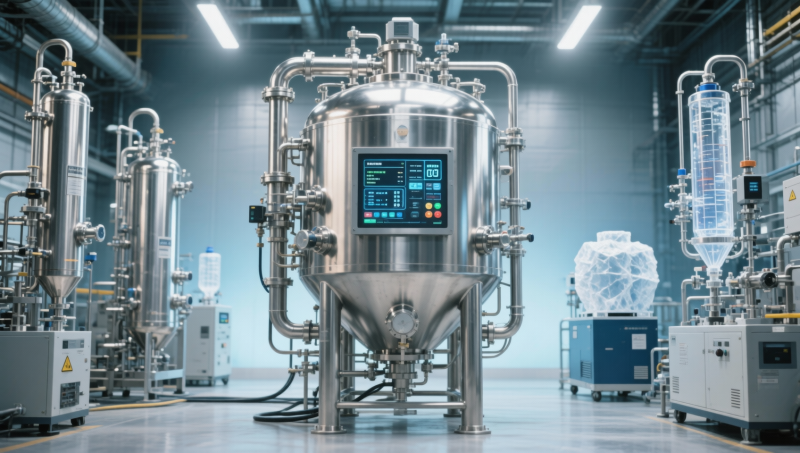
In the functional ingredient and industrial biotechnology sectors, moving a bioactive peptide product from initial laboratory design to large-scale commercial manufacturing is a highly complex process known as "Scaling Up."
Achieving a seamless transition from milligrams (R&D stage) and grams (pilot testing) to kilograms or even tons (commercial mass production)—while keeping structural purity and efficacy perfectly identical—requires advanced engineering, high-end infrastructure, and rigid process controls.
1. The Laboratory Stage: Milligram to Gram Verification
During the initial discovery and testing phase, the factory's R&D laboratory utilizes small-scale manual or semi-automated Solid-Phase Peptide Synthesis (SPPS) equipment.
The Goal: The core focus here is high flexibility, extreme speed, and strict verification.
The Output: The laboratory generates milligram-level test samples to conduct initial solubility checks, physical-chemical characterization, safety screenings, and preliminary active profiling. Technicians map out the foundational reaction curves that will later serve as the theoretical baseline for industrial synthesis.
2. The Pilot & Scale-Up Stage: Gram to Kilogram Process Parameter Reconstruction
Scaling a chemical reaction from a small glass flask to a massive industrial reactor is never a simple matter of multiplying raw materials by a thousand fold. It requires complete engineering reconstruction inside fully automated commercial production lines:
Computer-Programmed Automation: To eliminate human errors and batch variations, modern factories deploy digitalized automated synthesis reactors. Crucial variables—such as mixing intervals, amino acid coupling times, solvent washing frequencies, and temperature controls—are locked digitally into the centralized control system.
Thermodynamics & Fluid Dynamics Control: As vessel volumes expand from milliliters to hundreds of liters, heat dissipation and mixing efficiency change drastically. Premium manufacturers utilize specialized jacketed stainless-steel reactors coupled with fluid simulation tech to guarantee that chemical coupling remains perfectly uniform across massive volumes, preventing the formation of truncated or incomplete chains.
3. Commercial Purification & Lyophilization: Uncompromised Bulk Purity
Refining the crude active mixture at a commercial volume represents one of the most technical challenges of scaling up. While milligram batches can be easily purified via small lab columns, kilogram-level mass production requires heavy industrial hardware:
Industrial Preparative HPLC: Factories must operate large-bore, commercial-scale Preparative High-Performance Liquid Chromatography (HPLC) columns to isolate the target fraction rapidly and efficiently out of large volumes of crude material.
Mass Freeze-Drying (Lyophilization): The refined liquid peptide solutions are transferred into bulk industrial freeze-dryers operating under high vacuums and sub-zero environments, transforming the solution into highly stable, ultra-soluble crystalline powders.
This robust scale-up framework ensures that whether the factory outputs a $10text{ mg}$ sample or a $100text{ kg}$ commercial order, the peptide purity stably exceeds 95% or 98%, complete with identical batch-to-batch profiles and full Certificate of Analysis (COA) compliance.
4. SEO and Digital Marketing Compliance Guidelines (Google Ads & Regulatory Tracking)
When building high-converting B2B technical landing pages or optimizing ad copies for Google Ads targeting international supply chain buyers, digital marketing teams must follow precise communication parameters:
Focus on Measurable Industrial Capacity: Structure headlines and bullet points around factual, verifiable engineering metrics—such as computerized synthesis lines, industrial preparative HPLC equipment, daily/annual tonnage capacity, and standardized GMP or ISO 9001 operational environments.
Eliminate Medical and Therapeutic Claims: Under global advertising policies, never write copy suggesting that mass-produced peptide raw ingredients can be used to treat clinical skin pathologies, act as pharmaceutical alternatives, or treat physical disorders. Keep vocabulary strictly industrial, technical, and focused on raw material specification and formulation compatibility.